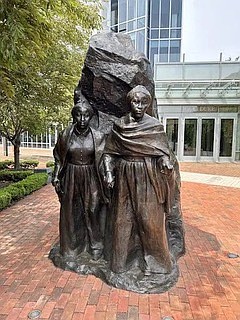
On November 8, 1848, two teenage sisters walked out of a slave jail on Duke Street in Alexandria as free women. Mary and Emily Edmonson had spent months behind its walls. Their story would soon reach Harriet Beecher Stowe and help turn the North against slavery.
Their father, Paul Edmonson, was a free Black man who farmed forty acres near Silver Spring, Maryland. Their mother, Amelia, was enslaved, and under the law her children were enslaved too. Paul managed to buy the freedom of four older daughters. The estate that held the family refused to sell him Mary and Emily, and the girls were hired out to work in Washington households.
On the night of April 15, 1848, Mary, Emily, four of their brothers and more than seventy others slipped aboard the schooner Pearl on the Washington waterfront. The plan was to sail down the Potomac and up the Chesapeake Bay toward freedom in New Jersey. Two days later, armed men aboard the steamer Salem overtook the Pearl near Point Lookout. On the morning of April 18 the captives were towed back upriver past Alexandria, and crowds on the wharves cheered.
The Alexandria slave dealer Joseph Bruin, of the firm Bruin & Hill, bought the six Edmonson children for $4,500 and locked them in his jail at 1707 Duke Street. A woman Mary had once worked for offered $1,000 for her freedom. Bruin turned her down. He expected far more in New Orleans, where the sisters were to be sold as “fancy girls,” young women sold for sexual exploitation. According to Stowe, even Bruin’s own daughter begged him to spare them. In May the sisters were shipped south from Baltimore.
In New Orleans, an outbreak of yellow fever gave Bruin reason to bring the girls back to Duke Street. Meanwhile, Northern abolitionists led by the Rev. Henry Ward Beecher were raising money to buy their freedom. Bruin set the price at $2,250 and threatened to send the sisters south again if the money came slowly. It was paid on November 7, and the next day they were free.
The sisters went north to school and spoke out against the Fugitive Slave Act of 1850. That law was sponsored by Senator James Murray Mason, who now lies in Christ Church Cemetery on Wilkes Street. In 1854 Stowe told their story in The Key to Uncle Tom’s Cabin, the book she wrote to prove her novel was drawn from life.
Mary died of tuberculosis in Oberlin, Ohio, on May 18, 1853, at the age of twenty. Her grave in Oberlin’s Westwood Cemetery has been lost. Emily married Larkin Johnson and settled near Frederick Douglass in Washington, where she died in 1895. Her cemetery was cleared in 1967, and where her remains lie today is uncertain.
Bruin kept trading in human beings until the Civil War, when he fled Alexandria and was later held in Washington’s Old Capitol Prison. He died in 1882. He rests in the Methodist Protestant Cemetery on Wilkes Street, beneath a marble obelisk carved with his family’s names.
So the slave dealer has his monument, and the sisters have no known graves. But outside 1707 Duke Street, Erik Blome’s ten-foot bronze of Mary and Emily Edmonson stands beside the building where they were held. Their story is also a stop on the Gravestone Stories From Enslavement to Justice walking tour.
David Heiby is an independent historian, founder of Gravestone Stories (gravestonestories.com), and Superintendent of the Presbyterian Cemetery & Columbarium. He is Treasurer of the Alexandria Historical Society and of the Virginia Trust for Historic Preservation, which owns the Lee-Fendall House Museum, and a member of the Alexandria Archaeological Commission.