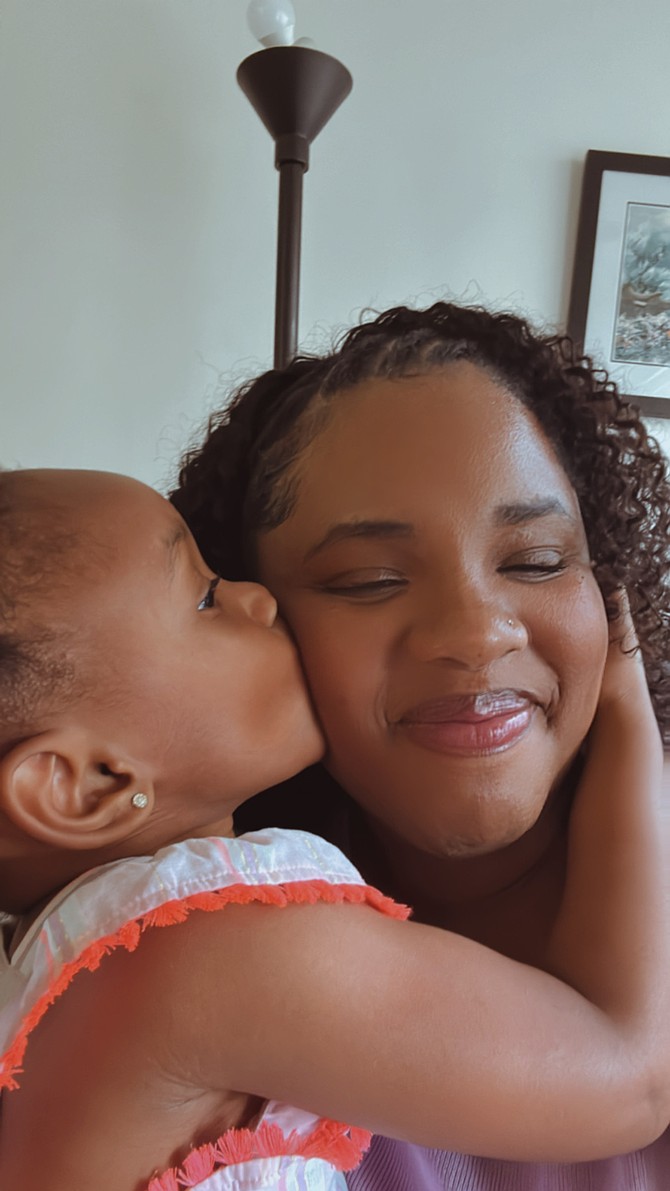
Zenda Daniels gets a kiss from her daughter Zemira-Grace, a symbol of the quest for restored independence; starting over does not erase tenderness, joy and presence.
Relocating to Arlington did not feel like a beginning. It felt like distance. A physical separation from a life that had already fractured before she ever left it.
For Zenda Daniels, arrival came after a series of exits that were not clean breaks but necessary escapes: leaving a home shaped by domestic violence and financial abuse, leaving work that could no longer be sustained through instability, and leaving behind a version of life that had narrowed to mere survival.
She arrived with her newborn and the quiet fatigue that follows prolonged uncertainty.
Transitional housing became the first stop in rebuilding, spaces defined not by permanence, but by shared impermanence. Temporary rooms. Shared kitchens. The steady stream of people trying not to take up too much space in one another’s lives while figuring out their own.
Before Arlington, there had been shelter life in New York, days structured around intake appointments, case management meetings, and the careful logistics of rebuilding safety from inside systems designed for emergency, not restoration.
“Every day felt uncertain, but I refused to give up,” Daniels said.
In the United States, domestic violence affects women across all demographics. Research from the Centers for Disease Control and Prevention (CDC) show that Black women experience higher rates of intimate partner violence victimization along with greater exposure to overlapping economic and housing instability than other demographics. These intersecting pressures can extend the impact of abuse far beyond the relationship itself, shaping employment stability, financial security, and long-term housing outcomes.
For Daniels, those patterns were not abstract. They were lived reality.
“My breaking point came when I realized survival alone was no longer enough for me or my daughter,” she said. “I needed to take back control of my future because I had my legacy watching me.”
Daniels found building blocks to take back that control through the From Caregiver to Breadwinner program at Marymount University, an initiative designed for those whose lives have been interrupted by caregiving or crisis. The 12-week training pathway provides training in IT fundamentals, artificial intelligence literacy, and cloud technologies, along with certification preparation, mentorship and job placement support. Since its launch, it has served more than 140 participants.
The program is housed within the Center for the Innovative Workforce and supported in part by a grant from the U.S. Department of Labor, along with industry partnerships.
“My breaking point came when I realized survival alone was no longer enough for me or my daughter.”
— Zenda Daniels
Jennifer Weiser, Project Manager for the Center for the Innovative Workforce at Marymount University, describes it as a bridge between lived experience and workforce opportunity, helping participants translate resilience into professional capability while providing structure for long-term career development.
“Participants come to us with extraordinary resilience, problem-solving under pressure, adaptability,” Weiser said. “What we try to do is help them recognize those skills as transferable, and then give them the structure and confidence to step into careers where those strengths are not only seen, but valued.”
Before the program, Daniels attempted to study technology independently. But without structure or support, the process felt fragmented.
“The hardest part was feeling overwhelmed and isolated,” she said.
What changed was not only instruction, but environment. Learning became shared rather than solitary. Others in the program carried similar histories of disruption, caregiving, or instability.
For the first time, education was not something she had to navigate alone.
Over time, she began participating actively, eventually leading study sessions for peers preparing for certification exams. The role shift was subtle but significant, moving her from participant to peer support.
Daniels’ existence once was shaped by interruption: psychology studies, customer service roles, nonprofit work, and healthcare support that never fully stabilized due to circumstances beyond her control. Time in shelter and transitional housing required constant adjustment, emotionally, logistically and financially. Even moments of progress were often temporary.
“My life was centered around survival, motherhood, and trying to rebuild after extremely difficult circumstances,” she said.
During her time at Marymount, she continued pursuing certifications and rebuilding confidence in incremental steps. For Daniels, the shift began internally before it became visible externally.
“For a long time, I identified mostly through what I had survived,” she said. “The program helped me see myself differently.”
Today, stability is no longer defined by crisis avoidance.
“Now it means something much deeper,” she said. “It means having vision, structure, goals, and the belief that my daughter and I can build a safe and sustainable future.”
That shift does not erase the past. It reframes it.
What remains is not a story of arrival, but of continuation, of building something durable after years in which durability felt out of reach.
And in that space between what was endured and what is now being built, Daniels is still learning what it means not just to survive but to prosper.
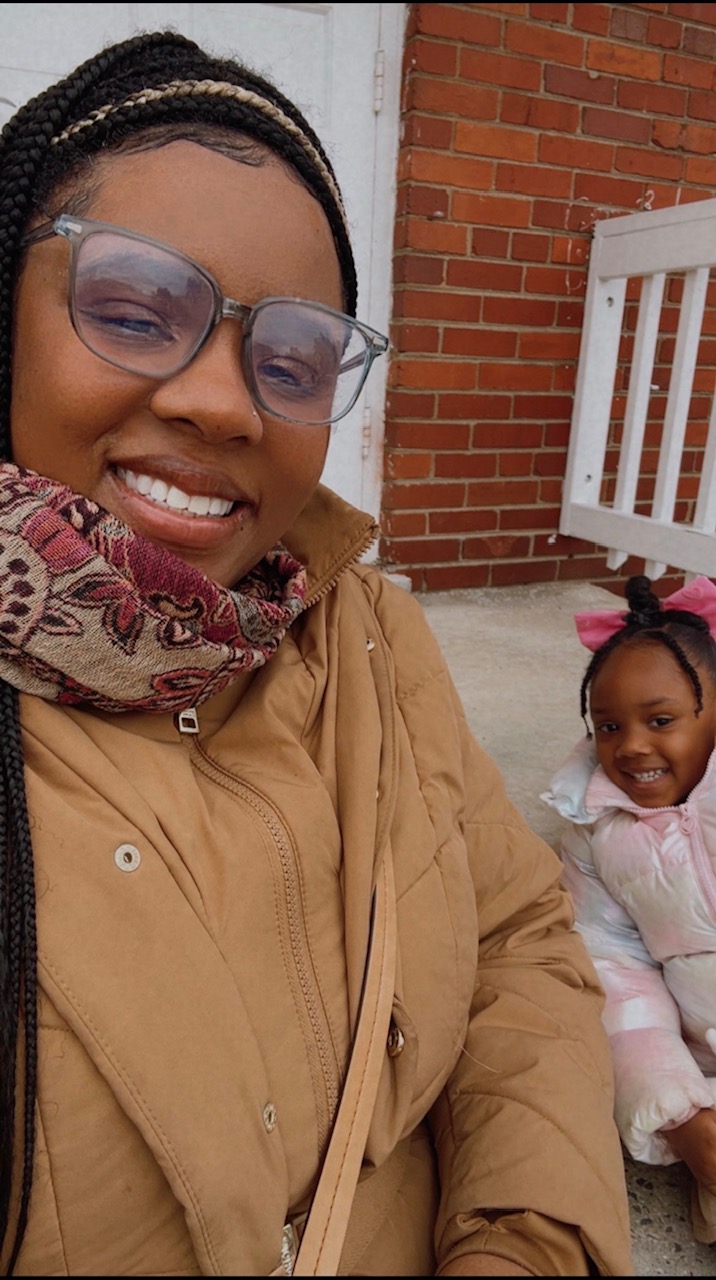 After time in shelters and transitional housing, Zenda Daniels hopes her daughter remembers not only the struggle but the stability she’s building now.