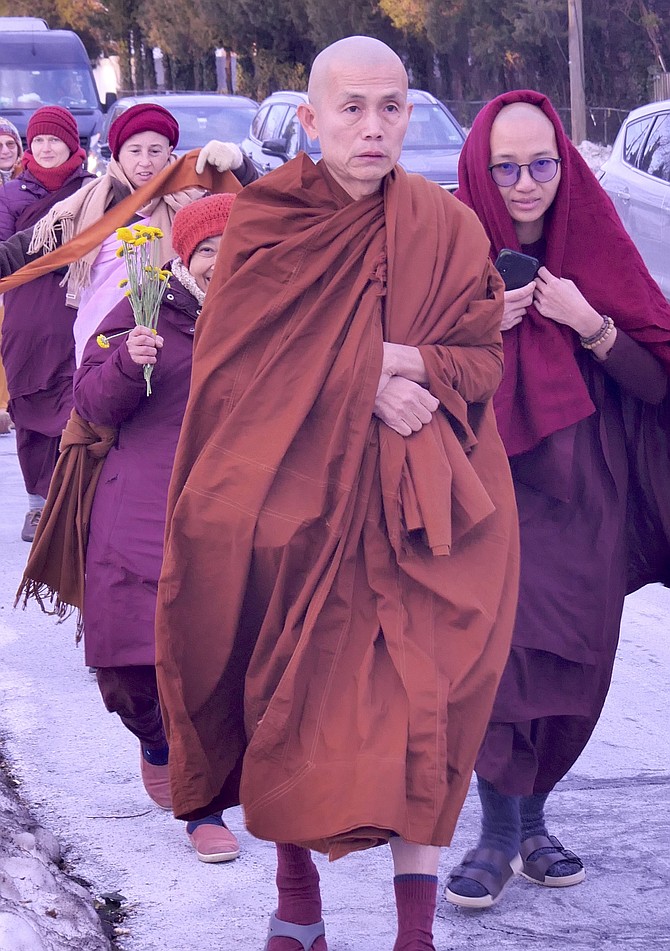
Ven. Bhikku Pannakara accepts a flower from a bystander along Glebe Road.
Venerable Bhikkhu Pannakara knew right away why so many people came out to wish him and his monks well. “Do you not have work?” he teased the crowd softly in his accented English. “Why so many of you here?” The crowd at Marymount University shouted back: “Because we love you!” But Pannakara knew the reason: “I see by so many people here today that you really needed this.” The crowd murmured agreement.
In his calm, and calming, voice, he advised: “Practice peace. We can forgive and let go. We have done so many things to hurt others and we can’t forgive ourselves … but let it go. Give yourself a chance to have peace. Close your eyes, focus on taking breaths, feel the air, hands on heart, feel your heart beating. Picture your parents. Think about the sacrifices they made for you. Maybe you said something hurtful. When you can forgive yourself and others, your family will also have more peace. We don’t need to run to finish; let’s all slow down.”
The crowd was quiet, many were tearful. “The atmosphere completely changed,” said Alina Moore, who attended the gathering downtown the next day. “It was like we were all suddenly on a different plane. People these days have gotten so intense, but it was as though the monks had literally shifted something in the air. We put our stress aside and felt at peace.”
The monks did indeed give off an aura, and this appears to be the reason Aloka the Peace Dog joined them. An Indian Pariah dog, Aloka, decided to walk with the monks as they crossed from India to Nepal. Pariah (outcast) dogs are considered dirty by many Indians, often eat garbage to stay alive, and are more likely to get a kick than a kind word along the way. The monks adopted him and even carried him part of the way when he injured himself. Since then Aloka has been a permanent part of their community.
Pannakara told the crowd how they could start to be more peaceful. He urged them to start their day, not with the cellphone, but with paper and pen, and to write down, “Today is going to be my peaceful day.” He asked the crowd to say the words as they read the sentence, and told them that by doing so, they would allow the sentence to enter into their consciousness more deeply. He reminded them that practicing peace means, “If someone provokes you, and you choose not to react, you win and they lose.” A gifted speaker, whose American education was evident in his ability to articulate his message, Pannakara went on. “The road always has ups and downs. It’s like a rollercoaster. It cannot be flat. Don’t be discouraged.” Pannakara’s group of 19 monks were tested by the weather, illness, and a distracted driver who crashed into the group, causing one monk to lose his leg. That monk chose to view the loss as his “contribution to peace.”
Later that evening Pannakara told a packed auditorium of Marymount students, “Stop carrying around your lover all the time, even sleeping with your lover and even going to the toilet with your lover.” The students laughed. They knew he was referring to the ubiquitous cellphone. “I know what it’s like,” he said. “I’ve been there, done that. You are stressed and you think if you reach for your lover, it will help, but it does not help.” In fact, he told the students, “You lose focus and you can’t concentrate, and that just increases stress. Be mindful, breathe, and be aware of your breath. That is the way to regain your focus.”
Pannakara has been there, done that. After immigrating from (originally South) Vietnam’s Đắk Lắk Province, he studied at the University of Texas at Arlington and got a degree in Information Technology. An IT engineer, he worked for Motorola until he gave up his job in 2007 to become a novice monk, ordained in 2010. Since then he has followed the Theravada school of Buddhism, adhering to a strict, disciplined lifestyle aimed at enlightenment. These monks live as part of the Sangha (community), relying on alms for food, meditating intensely, and providing spiritual guidance to the laity. Celibacy, not handling money, and eating only between dawn and noon are just three of their rules for living.
Pannakara is now vice president of the Huong Dao Vipassana Bhavana Center, located in Fort Worth, Texas. He told the crowd he was not at all sure his walk across the U.S. was the right thing to do until he started seeing the crowds of people who came out to watch the monks walk by. The monks may have moved a great many people along the way, but they were equally moved by the response they received.
To learn more about the Huong Dao Vipassana Bhavana, see: https://www.facebook.com/chuahuongdaotemple/?locale=vi_VN