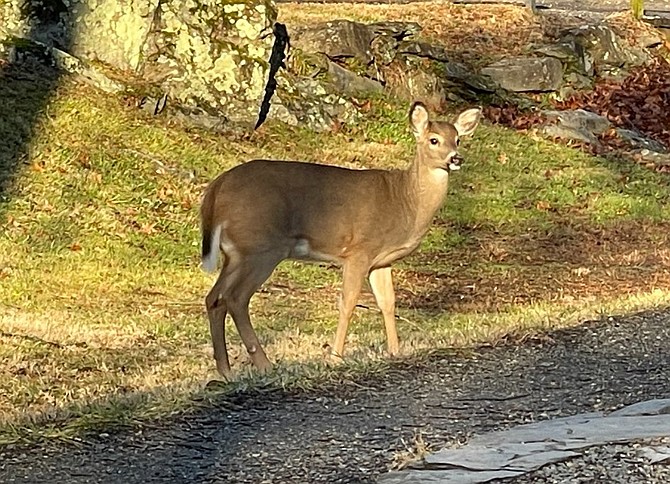
Adam Segel-Moss, Arlington Parks and Recreation, is someone who, like many of us, is often stunned by the beauty of a buck or a doe looking up at him as he walks through the park. But he had to break the news to a large crowd Thursday night that the sharpshooter program to take down some of those deer is going ahead in February, and why. With gentle country music opening up the presentation, Segel-Moss sensitively described the long lead up to the effort to manage deer, noting that many people, including his family, struggled with the concept of killing deer. But, after a long-term comprehensive effort to let the community know what the options are, it is time to face the conclusion: interrupting the reproduction of deer by shooting (mostly the does) in eight different parks where the deer have been the most destructive is the most humane, time efficient, safe and effective way to meet the goal of the program, preservation of our forested parks.
While originally 55 percent of the population who weighed in on deer management were in support of deer management, how to do it was hotly debated. Sixty-three percent wanted surgical sterilization of deer, 43 percent wanted sharpshooters to reduce the deer numbers, and 34 percent wanted to use archery to reduce the population. Later, in Round Two of public engagement, 85 percent of the population in Arlington wanted to manage deer, and 80 percent were in favor of sharpshooters. The decision to go ahead with sharpshooters had to take into account multiple factors. Segel-Moss made it clear the County has given a lot of thought to this and researched every possible alternative.
John Marlin, Deputy Division Chief of Parks and Natural Resources Division of Department of Parks and Recreation explained the details. Marlin reviewed the impact deer have on the whole eco-system of the parks, including flowering native plants, insects, birds, small mammals, trees, and the health of deer themselves. He told the crowd that one of the problems is that the acorn-bearing oaks are “deer candy” and losing so many oaks is catastrophic for the rest of the eco-system that also depend on them. No matter how much you like deer, it was clear from the data that some deer had to go.
The sharpshooters, who are all certified professionals, many of them ex-military or police snipers who know how to aim for the least amount of suffering for the animal, will be operating for one or two nights in each of eight park areas sequentially. The parks will be closed, combed for anyone who disregarded closure signs, surveilled, and closely monitored to make sure no one gets hurt and that deer are dead once shot. Shooters will aim down from stands, and will use lead-free bullets. Primarily female deer will be targeted as they are very efficient reproducers and without any predators, are the reason the parks have too many deer. Some bucks will also be targeted as they can be more destructive.
The plan is two pronged: sharpshooters to immediately reduce the population and then trying to save the undergrowth by using deer repellents and putting in small scale fencing. The plan will incorporate data driven adaptive management using aerial surveillance to see what improvement takes place in terms of population reduction and forest rejuvenation. The goal is not eradication of deer but balance in the deer to park ratio.
On the good news front, the two presenters noted the County will partner with “Hunters for the Hungry” so that all meat will be tested and once found free of disease, will be sent to the Arlington Food Assistance Center (AFAC.)
The presentation was well worth watching for those who want answers to questions like “Why can’t coyotes reduce the deer population?” and “Why can’t we just move some of the deer out of Arlington?” To watch the presentation or to get on the mailing list for updates, please see: https://www.youtube.com/watch?v=kVJbh587VBY and https://www.arlingtonva.us/Government/Programs/Sustainability/Ecology/Deer-Management-Program